Today’s announcement of a big bailout worth 150 million for an Ethylene plant is a great way to explain its relative position in the production system in our current economic paradigm.
As background you can read more on this support package on the BBC or in other news sources. I wanted to briefly comment on this here using the production network AIPNET we built as a source.

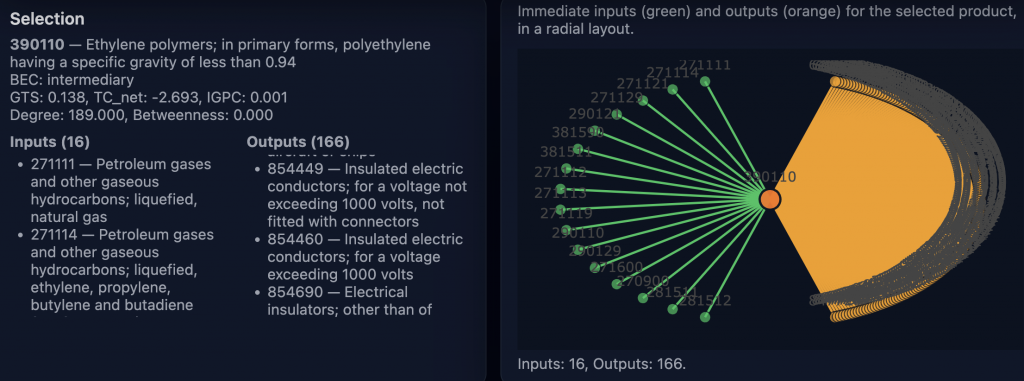
Ethylene is a basic polymer that, as a basic material, has many onward uses. This means its very central in a production network with many outdegree links or onward uses and few inputs. This is quite visible when we plot the ethylene in- and outdegree links in a HS6 production network view in a 3-dimensional vector space.
Flattening it out into a two dimensional view it exhibits the topology of this more clearly. You see few indegree links (inputs) and many outdegree links. This has the hallmark of a good that is just central to many existing production processes in our current economic paradigm. This naturally highlights that such an industry may be of high importance and may help explain or put context around why it was benefitting from public funding.
But what is more? Across all physically traded goods, ethylene polymers have a set of features in the global trading system that may warrant countries to be particularly mindful of minding such a basic industry if there is an expectation that it will continue to feature prominently, even in a more sustainable production paradigm that we may be moving to (think: circular economy).
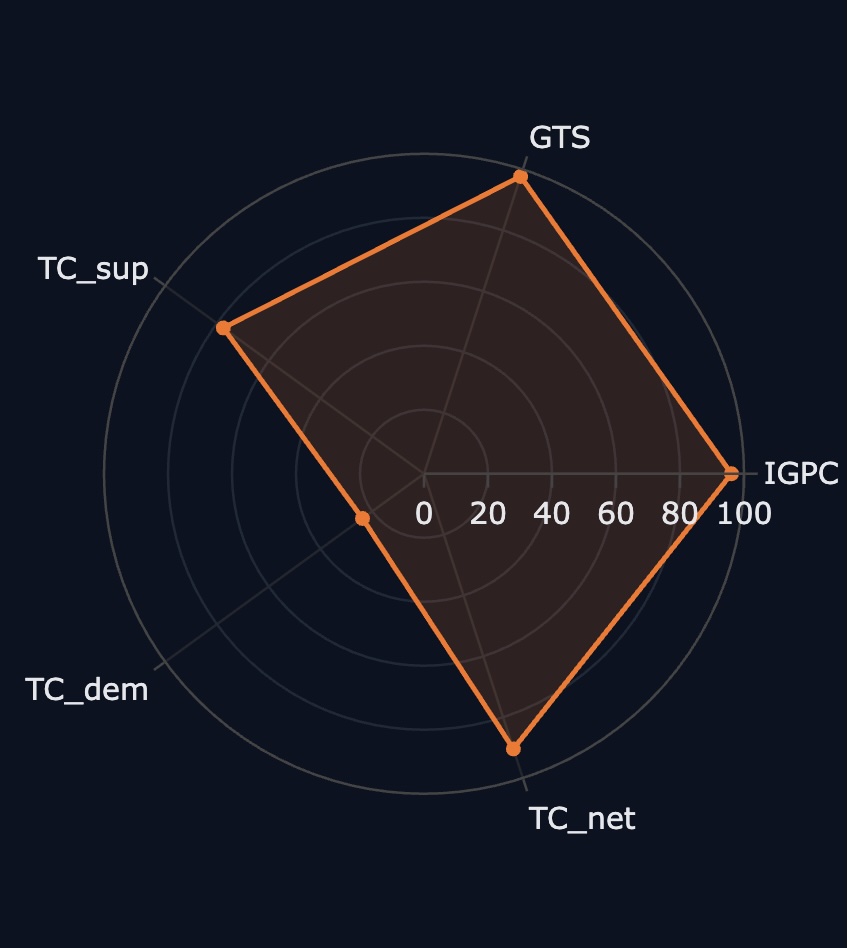
You can see this in the plot below. This plots a radar plot capturing different dimensions of ethylene in the current trading system. It presents a measure of supply and demand concentration TC_dem, TC_sup (a Herfindahl index) globally. This is expressed in percentiles relative to all global trade across all other goods.
You see that supply is much more concentrated than demand, it is a big part of global trade through having a high global trade share GTS and it has high iterated centrality as measured through our IGPC product centrality index.
It should be obvious that this may be a good where losing the capability to produce it could undermine strategic autonomy or bake in dependence on other countries. While dependence per-se is not a bad thing, after all, trade is important vector for economic and social development, it can become a vulnerability in particular if supply is very concentrated for a good that is a high importance to the production paradigm. As media covers this story its worth highlighting this.