I wanted to start this chain of thought with a “cute” illustration of a use of generative AI for image creation. It will not be long and one can “share” one’s own personalized life story as full length feature short-series to be marketed as digital assets. That is one way that AI can lead us to a celebration of human life. This is an, IMO, positive view of how things could evolve. It may also help in contrasting the posturing of popular programming that, at times, comes with a glorification of “heroes” that may often may be “villains” in popular culture (not sure if this is a desirable programming); an alternative is to think of fictional characters with superpowers. When in fact, many of the heroes are unsung heroes. Never to be heard of or from. And of course, who or how it is determined who is “famous”, well, that is an “interesting question”. In any case, conceptualisations of what is a “good life” may vary across cultures.
But it may also come or be the product of a specific way of conceptualising human flourishing. Seeking the limelight of attention may be a path that may come much easier to people socialized in (much) more individualistic societies.
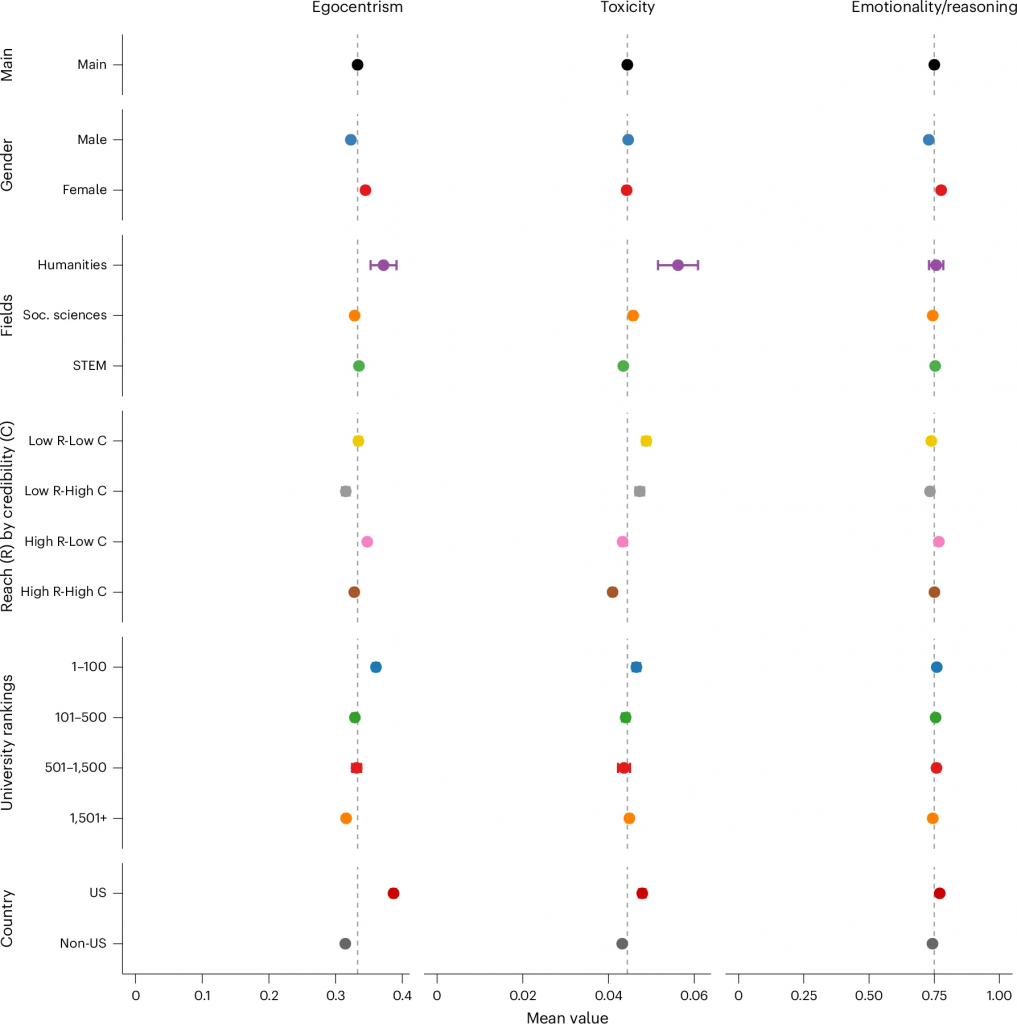
Some of this thinking is reflected in our Nature Human Behavior paper on academic expression online (see the Figure below). The structural differences on style and tone have US based academics standing out with much more pronounced individualism, toxicity scores on average relative to non US-based academics that engage in online discourse on Twitter.
Basically: the output that is shared by US based academics on social media is more notably different and my read of the high dimensional pattern it is simple: the content is the product of a society that lives and breathes individualism, competition etc. This may create excess returns for people to “cut corners” and “optimize for salience” or “attention”. I feel this is something that makes the process of societal stewardship really difficult, as naturally, it may create a talent conveyor belt that may promote, in particular, individuals with narcissistic traits or “bullies” or, well, whatever you may think shapes incentives.
Knowing ones own attention mechanism is really key, in my view, to understand individual flourishing. But this is an aside.
Attention is all you need in a post materialistic society where humans look for recognition, status and the likes in any vector space that may represent “status”. This includes humans serving as role models, reference points, but could extend even further to the idea that deep programming (think yourself what this could entail) induces humans as a species to look for “leaders”.
But this also raises a host of other questions. The above example illustrates a few things. First of all, just as with artists, there is a question about using one’s likeness or photo (ones biometric data). Who owns said data? Can others use anyone’s picture that they find online to create such a visual? Similarly, there is the question about the use of logos of entities or outlets here and of course, in some form this all links to issues of trade in services.
Global challenges and governance issues And this is where I keep coming back to the fact that the global system of governance for trade flows in data is incredibly weak. There is no established global trading rules for trade in digital assets, data and the likes. Since 1998, there has been a moratorium that there be no tariffs on trade in data or ecommerce products. This moratorium has been in place and keeps being renewed. But with the global situation developing and with an adversarial posture of, in particular, the US and China in some dimensions, it is increasingly questionable if this moratorium is upheld.
South Africa, India, Indonesia and a few other players are pushing against it. And hence it may not be surprising why the US administration is pushing so aggressively around these countries with a specific goal to embed these. I was surprised that China quietly acquiesced to the US carve out around the global minimum tax agreement, but given that it doesn’t have much market access in the digital economy (or is closed for investment…), it may be rationalizable. Though could be also a barrier to a more equitable trading system.
The UK struck a clumsy trade agreement with the US that kept language explicitly vague, but the US, in essence tries to establish everywhere a ban on data localisation mandates which, in the worst case, may disempower legal systems around the globe. This may have been a strategic move to manage the Trump administration that is quite erratic and may be slowly coming around to understanding that there may be nuances around speech. It is my perception that some players aim to use their reach and their knowledge of our ourselves through our digital traces to effectively shape specific interest coalitions across societies to ensure that the moratorium is extended or made permanent.
This can be done by, in essence, creating an alignment of incentives of powerful stakeholders. Nevertheless, at the same time, Donald Trump is eroding the underlying trust that is necessary. And again, this is where I think its very important to understand the mindset and programming of an individual. Some geopolitical players have been doing this quite well. At the same time, China is building parallel structures that may be increasingly difficult to ignore especially in light of the US aggressive stances or “bullying”.
It is obviously possible to foresee how an international governance structure around trade in data may look like. We could all work on shared global digital asset register with each and one of our data or digital assets being linkable and traceable to ones digital identity. This is why in my lectures I highlight this chasm and tension that is playing out forcefully and most notably between China and the United States.
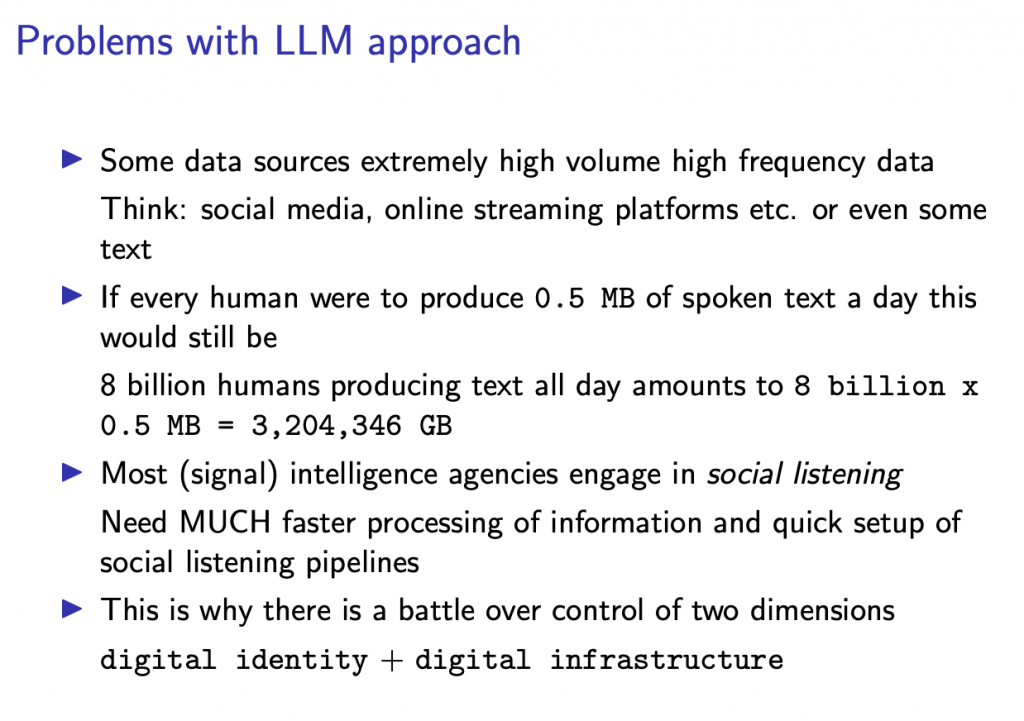
Ultimately, this chasm can be fixed if we move to shared global compute infrastructure or storage infrastructure for digital assets, potentially based on an immutable protocol. Yet, this invariably may undermine the perceived powers of some players to use stories or narratives to influence or “interfere” in others societies. It may also create even more tensions. And plurality of narratives and stories I think in many ways may be conducive to healthy societies that are governed by plurality. But in an international setting where we need to be able to convey state safe binaries and engage in data-based diplomacy this imposes some challenges because systems of sharing of data/knowledge between countries are not living in that world (yet). But it strikes me as imperative to help tackle global challenges such as climate change.
In fact, as I argued elsewhere and before it makes interference in societies possibly in a way that has never been seen if it comes with poor governance.
At the same time, this very same technology also holds great promise to tackle global development challenges. For example, if a lot of the barriers to trade in ecosystem, biodiversity or carbon sequestration services , which are crucial to create valuations for ecosystems and biodiversity, relate to the challenges of state verification and a lack of traceability. What if it were possible e.g. to trace the supply chain of a CO2 emissions certificate end-to-end? What if it were possible to validate claims relating to climate credentials sharply and quickly through an audit trail that is supported by a trust layer that, ultimately, starts with some ground truthing? This is what my hope is around start ups in the smart decarbonization space that do not ignore the supply chain.
But the view here in G20 countries between the US and other players could not be more different here as I highlighted in this post on stablecoins and VAT. I keep on iterating the importance of this. The ability for shared global governance, the idea of “sovereignty” stands at disposal.