Let me share an anecdote, or something, how one “could” have made some money off some information or a reasoning trace a while back. Simply, by applying logical reasoning on the backs of a “reasoning” trace that seemed plausible as a narrative. This also serves to highlight the importance of all of this and this is why I believe that the value of superintelligence should be undefined — this does have direct implications for the viability of our present financial system and “in the race” to superintelligence.
So what happened? Late in October, I was working – as in, thinking – through the implications of the shock that is implied by the Nexperian US/China deal. This is a deal that some say, was designed against the EU. The context: Nexperian is an EU based silicon waver producer. They produce relatively low grade silicon wavers at 100nm. They are mostly used in the European automotive industry that, thanks to a political system that flip flops and injects uncertainty into the system, has struggled with bringing cars “back to their electric vehicle roots“.
You can find my reasoning trace here. The valuation of the company has since nearly shot up by 60% from around USD 30 to around USD 50…
What is happening with these chips produced in Europe is that 80% of the wavers are sent to China for processing. There these chips are tested, and packaged for final use as components for cars, and typically shipped back to Europe to be integrated into vehicles. The automotive supply chain has numerous such cases of forward and backward crossing of components, somewhere else I referred to this as the “spaghetti supply chains“.
The recent US/China deal has led to China simply cutting out Nexperian wavers from its production processes. They can source the 100nm wavers also locally, and, so it seams, increasing domestic value added. That is a “potential” win-win for the US and China as they cut a deal, but it may be perceived to be at the expense of Europe, as the EU may now get fully supplied with much higher Chinese “content”, cutting out the European waver plant.
So what are the implications if you think this through as an economist — which I did on the weekend of October 30. And of course, I was using AI to aid this — but its basically an indirect illustration of what a knowledge graph built along a nomenclature, along with information on companies, etc and a production network like the AI Generated Production Network may facilitate going forward.
One way to think of it is that there now is a positive supply shock of 100nm wavers. These can be put to domestic use, but the key benefactors of such a positive supply shock would be firms that can process these wavers in Europe.
After a bit of search, you arrive at the conclusion that the only entity that appears to have positive supply capacity in this space is — Amkor Technologies. This triangulation was done through multiple iterations.
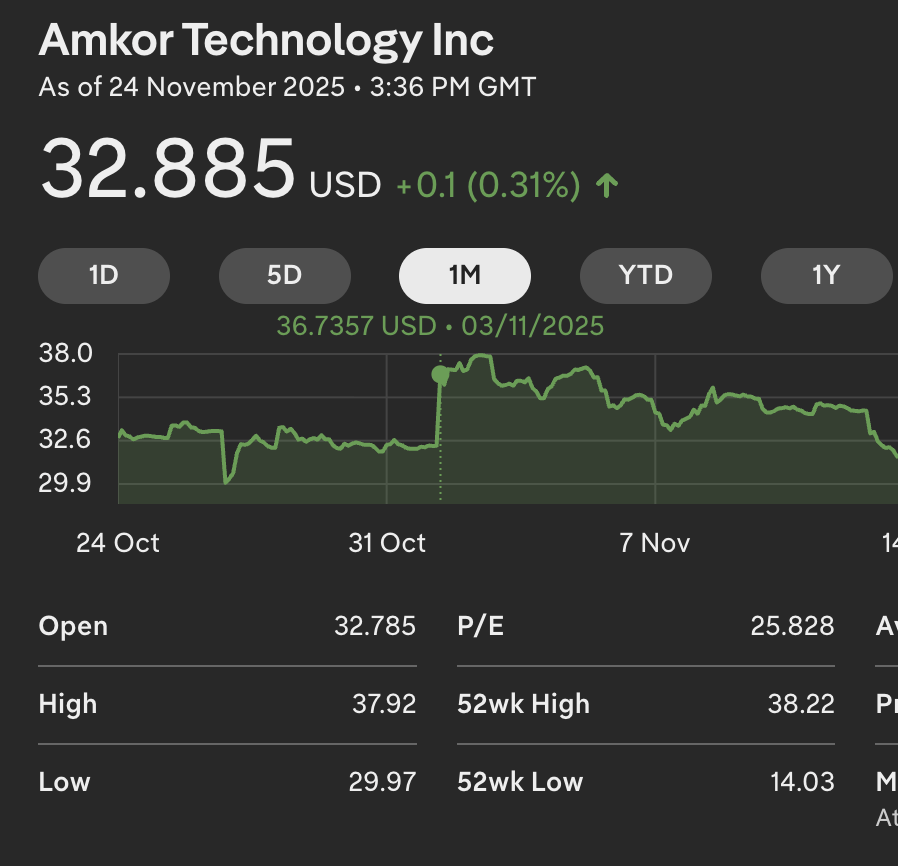
And surprise surprise — Amkor “popped” on Monday as trading resumed. Of course, Amkor also “beat” in their earnings which was released the week before, and so there could be many other factors that contributed to the “pop” but it would be strange to think that such a response was not immediate. One could have positioned oneself already on Friday as the “deal” between China and the US became apparent on Thursday.
Ridiculousness and the rise of superintelligence
In any case, why do I think this highlights the ridiculousness of the race for “superintelligence”.
Well. First, the origin of this “shock” is owing to Donald Trump’s aggressive trade policy stance. This is humanly shaped. This is what created the “space” for such a deal to be struck. But suppose you build a system that reads “signals” such as reporting on news, this creates a ton of attention to every word that the person that is the source of the shocks – Donald Trump – is babbling. Or, the content that we get to hear from them is, well, creatively cut together. Because there is concrete and hard money to be made if you couple this with reasoning capabilities. And, despite the deal being announced on Thursday, October 30, it took until November 3 for this to be reflect in the market valuation of the company. Since the peak, the valuation has declined again back to normal.
Shaping news shocks
Now, if there is money to be made of such short term news shocks, this creates a rat race for speed and reasoning ability, and a strong interest to shape the narrative around a shock. And this is where AI comes in. Being “faster” can be worth a ton of money but it encourages a lot of resources to be devoted to being “the fastest” around short term trading activity, or types of knowledge arbitrage that may be short lived.
And being the “fastest” requires the processing of ever more data and compute and energy. As the race “narrows”, the bets or the gambles will have to get ever larger as the probabilistic margins may get smaller and smaller and this raises the question about the tail risk that may come with “getting things wrong”. That is: we have extreme concentration of material financial resources to acquire the information that is necessary to make such large bets in the context of ever smaller margins along which such an investment could be profitably be made.
So, we can establish, that short term focused investing, like, day trading or arbitrage of that sort may be catastrophic. I can not imagine that we can continue in a race equilibrium unless we completely forgo the idea that there is human agency and/ or accountability, as we will hand over governance to a model.
This also has the corrolorary that privacy is an absolute must. Only this way can you ensure that there is the narrative plurality that is necessary for stability to be possible.
Now on the more conceptual side. Value and valuation is a social construct. In my socials I keep on using the example that Elon Musk does not have a better phone than I have. Meaning: we are actually very similar in physical goods consumption terms. Probably not in terms of services, but if anything, the AI revolution highlights how the service-sector side of the economy is entirely malleable.
It also highlights the conundrum and the challenge that China poses in the context of an economy that struggles with balancing itself. Of course, I think demography here is the biggest driver.
In any case, do we think that a more intelligent human could explain a less intelligent human that they are “super intelligent”? Maybe not. Or I have my serious doubt about that. But even if they were to, ultimately, its about putting that super intelligence to work in order to see that it provides results. This could be done e.g. in the financial services. But deep down, in the absence of the possibility of state verification around intelligence, it boils down to trust.
Putting super intelligence to work requires us ultimately to pledge assets to it. Or what we perceive to be financial resources. I have a hard time seeing that humans would not judge the morality of the acts of super intelligence being put to work conjointly when evaluating the character of the individual or entity that represents super intelligence.
Meaning: even the last vote is a vote of confidence or trust. And I feel like we can and completely have to rebuild a global trust anchoring. And this seems to be underway, with e.g. the UK now moving to public companies house with proper identity verification. This means we can implement a vision in which ultimately compliance will become a simple lookup on a public trust ledger that is stewarded. I am hopeful this can also help us shift to a model of rethought systems in many ways, from public procurement to industrial policy, among many things.