One of the most shocking things somebody that is very “successful” in life on some metrics was the following: I really hope none of my kids are stupid. I found this insanely irritating and shocking in so many ways. It spoke of the parental anxiety and fear that suggests that lives of children with less cognitive complexity, intelligence or however you may refer to intelligence can not expect to have dignity in our world.
He would probably disagree, but the perception that my generation and the generation that follows is quite unable and unwilling to entertain the risk of bringing children into this world speaks of the anxiety around the social contract that governs interpersonal interhuman co-existence on this planet.
We are now entering a slippery slope of a world, where for some, even traits like intelligence are effective choice variables. The ethics of genetic engineering and modification, of selection of embryos and the likes will make it possible to engineer life in ways that, well, fundamentally upset the human condition. And this is also a context in which we can interpret the shocks that artificial intelligence will imply for humanity. How so? Well, it effectively devalues intelligence or the perception of intelligence. It limits the comparative advantage that those that are smart or faster in some conceptual space can accept.
I do think that the devaluation of human intelligence is the only logical conclusion if we adhere to the idea that, before the veil of ignorance, before the veil of not knowing, we are all equal. That is: if parents perceive the worth or value of a child is a function of its perceived intelligence, and if we can make intelligence of a kid a “choice” variable, the only logical conclusion that is consistent with an honest & caring view of the human condition is to devalue intelligence.
Humanity has learned to flourish through specialization, trade and interdependence. And most societies have managed to develop a system of knowledge transmission from one generation to the next. The one thing that makes humans unique is that we all enter the world with an empty brain and its the challenge of every generation to pass on knowledge.
Flourishing it is? In any discussion of what it means for a society to “flourish”, one quickly discovers that the notion is not a vague moral aspiration but a set of concrete conditions. I think flourishing must guarantee moral equality and unconditional dignity. Every person is treated as an end in themselves, not as a pre‑evaluated product whose value is measured against a standard of predicted productivity, IQ, beauty, or any other trait.
It must foster social cohesion and mutual recognition: people must see one another as fellow humans, not as members of a caste. This requires a shared fate, a mixing of class and ability, and institutions that translate complexity so that individuals with heterogeneous cognitive capacities can participate.
This does require for societies to embrace this, to ensure that there is an honest intergenerational promise. The “lottery of life” should be accepted because children, whatever their draw in the lottery of life can expect protection, education, self-discovery, identity and recognition. Parents should feel that they are not simply throwing their offspring into a grinder.
A key part of this recognition is that humanity survived and evolved to operate in collectives, or various forms of what we may consider to be societies. And as such, societies needed to find ways to both, develop, detect and identify talent. This process is embedded in an education system that is a recognition that as humans, we arrive in this world with an empty brain. And it is a collective task to decide on what is the set of skills, knowledge and understanding that we want to instill into the next generation. Education is a matter of resilience. Education systems are the product of human evolution and in essence, most working relationships involve some degree of skill and knowledge transfer that is vital to human survival. Of course, this is something that can get hugely disrupted by AI as I chimed at the start of last year.
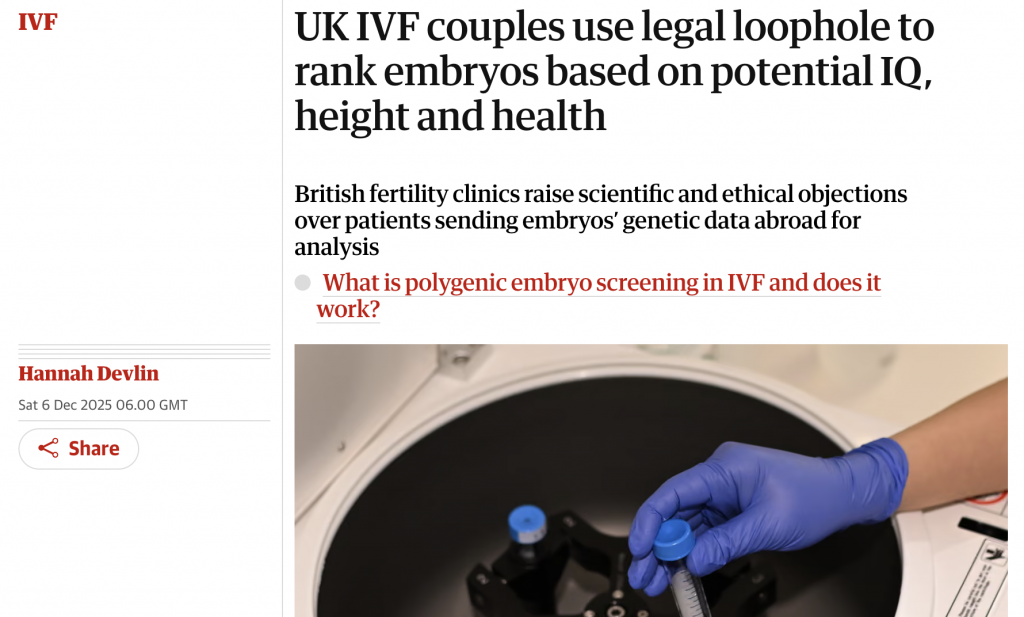
On the possibility of genetic selection This article on the possibility and lived reality that some are engaging in polygenic embryo selection in the United Kingdom shows that the practice is far from a medical safeguard against single‑gene disorders. Instead, it is a deliberate attempt to rank embryos on predicted IQ, height, and health. The method exploits a legal and data‑protection loophole to obtain raw genetic data, send it abroad for polygenic scoring, and then use the results to choose which embryos to implant. The practice is not permitted in UK clinics, yet it persists because it satisfies a deep‑seated fear among parents: “I hope my child is not stupid.”
In a society where status is already signalled by education, language, accent, and spatial segregation, this technology plugs directly into a pre‑existing hierarchy and promises to turn it into a hereditary, bio‑coded one.
Selection Presupposes and Entrenches a Hierarchy of Human Worth
Ranking embryos by predicted IQ or similar metrics is to act on the assumption that “some lives are, in expectation, more worth having than others because they better match the traits our status economy rewards.” This assumption is far from neutral. First, it turns equality into a lie: children born with low scores are implicitly told that they are the worse roll of the dice, a tolerated failure of optimization. Second, it naturalises class and status differences by rebranding social inequality as “nature.” Finally, it shifts responsibility away from institutions and onto the genome. Faced with rising complexity and unequal access, society can either redesign systems to accommodate heterogeneous humans or redesign humans to cope with ever more complex systems. Active selection chooses the latter, thereby absolving institutions of their obligation to translate, to accommodate, and to distribute risk. Once these consequences take hold, the very foundation of moral equality and unconditional dignity is structurally undermined.
Genetic Selection Supercharges Stratification and the Rat Race
The United Kingdom already exhibits spatial economic segregation: rich and poor live in different neighbourhoods, age‑segregated spaces proliferate, and local commons decay in poorer areas. These structures already produce assortative dating and mating. Adding polygenic selection only amplifies the effect. The service is expensive, so only the well‑off can afford it, allowing them to stack the genetic deck on top of already stacked education, housing, and networks. Others are left in a position where their children are, by construction, relatively unoptimised. The result is a society that feels coerced into a race: parents who do not participate risk condemning their children to a lower rung. The culture becomes one of escalating selection rather than shared fate, corroding social cohesion and mutual recognition. Children are raised as projects to justify investment, not as beings with open‑ended value, and institutions increasingly optimise for a narrow, high‑IQ elite, leaving the rest to fend for themselves.
It Undermines the Intergenerational Promise and Rationalises Disengagement
Young people today already face climate breakdown, housing unaffordability, stagnant wages, attention economies, polarized politics, and decaying local commons. In that context, the emergence of a genetic status market sends a clear signal: “The game will not be made fair; your only hope is to optimise your children’s genes.” This makes parenthood feel morally dubious and strategically hopeless. If others are buying genomic advantage while institutions fail to address structural injustices, it becomes rational to ask: “Why bring children into a world where they’ll be ranked from conception?” The promise that bad draws are cushioned is broken, and reduced fertility and youth disengagement become structurally reasonable responses. Knowledge transmission, which depends on universal public infrastructures such as schools and civic spaces, becomes politically less attractive when investment is directed instead at pre‑selecting “the best.” The honest intergenerational promise dissolves into a conditional, exclusionary one.
It Erodes Human Diversity and the Texture of the Human Condition
Active selection for socially prized traits forces society to answer questions that are otherwise left to cultural and moral debate: what is beauty? what is intelligence? what is a desirable temperament? When those answers are operationalised into scores and algorithms, the population begins to converge. Over time, traits cluster: faces and bodies trend toward a narrow aesthetic; cognitive styles converge toward what current status structures value; outlier traits that often generate creativity, resilience, and new forms of cooperation are selected against. The core feature of the human condition—that children arrive as radical surprises—is systematically minimized. This is an attempt to curate humanity into a designed product line, a quasi‑theological hubris that resembles painting a secular image of what the “best human” should look like. Such a society is less interesting, less robust, less adaptable, and less capable of the decentralized cooperation that has allowed our species to flourish.
It Locks Us into “Unholy Coalitions” that Block Course Correction
Polygenic embryo selection will be driven and protected by coalitions that span class lines but align on status. Tech and medical entrepreneurs market genomic optimisation as empowerment or responsible parenting. Anxious middle‑ and upper‑class families fear being left behind in an AI‑driven economy. Political actors channel these fears into culture‑war narratives while leaving underlying inequalities untouched. These coalitions are emotionally charged, status‑aligned, and structurally opposed to regulation that would subordinate markets to dignity‑based constraints. Once entrenched, the window to say “we shouldn’t have done this” closes quickly, even as social harms accumulate. Path‑dependent lock‑ins push systems toward collapse not by a single decision but by a series of incremental, self‑reinforcing choices.
Why Flourishing in a Human Sense Becomes Impossible Under Normalised Selection
When all the pieces are put together, a picture emerges that is starkly incompatible with the conditions of human flourishing. Equality and dignity are hollowed out by pre‑implantation grading; cohesion and mutual recognition are corroded by a biologised hierarchy; the intergenerational promise collapses because young adults rationally doubt that their children will be protected or valued; human contingency and diversity are systematically targeted, reducing surprise and outlier traits to noise; political and economic lock‑in via unholy coalitions grants disproportionate power to those who benefit most from the system. A society that can still function in the short term—growing GDP, publishing papers, launching AI models—does so as a high‑tech livestock management regime for a curated subset of traits, with the rest of humanity relegated to waste or afterthought. If flourishing is defined as a durable state in which humans can live meaningful lives with dignity, belonging, and a credible intergenerational horizon that respects our evolved social nature and diversity, then a world that systematically commodifies and optimises the genome for status traits cannot meet that definition once the practice scales. The prerequisites of flourishing and the logic of active genetic selection are in structural conflict, and the only viable path forward is to recognise and dismantle that conflict before it locks society into a fate of relentless stratification and inevitable disengagement.