I wanted to share a longer reflection that connects a few threads I have been working on over the past years: narratives, validation, platform competition, and the political economy of information systems. This is drawing partially on slides from the SHAPER keynote from 2023. The immediate trigger for this is a line of thought I have been discussing in talks and ongoing conversations and I think its worth just drawing the attention to this connection and this chain of thought. Attention markets can become structurally unstable when the reward to effort is locally convex, and they become convex incredibly fast depending on the network topology.
The core point is quite simple. In many information environments one extra unit of effort does not yield one extra unit of reach. In a dense network it can trigger a chain reaction: a bit more effort improves content quality or timing, that creates slightly more early engagement, the engagement is interpreted by ranking systems as relevance, and the content is then shown to a much larger pool where it gets even more engagement. So reach feeds on reach. That is exactly how the effort-return schedule becomes convex over the relevant range. Once this happens, the market starts to resemble a tournament, and in tournaments, incentives become zero sum very quickly (the pie of “attention” appears fixed). As a result, actors overinvest in strategies that maximize visibility, not necessarily quality. This applies to social media, but also to adjacent systems where status, citations, symbolic rewards, or cultural dominance are being allocated. Basically: any form of media as I reflected on the origins of the US exorbitant privilege.
The point of this is being made very nicely by a great young scholar at HK University — Jasmine Yu Hao. It emerges across her work in empirical IO, that touches on various aspects of platform economies, broadly defined. In some new empirical work, she studies and aims to rationalize the impact of caps on earnings in Chinese online streaming markets. These caps, she argues are the product, de-facto of industry self regulation.
But lets look at the deeper issue of payoff geometry first.
The Geometry Problem
If the reward function is locally non-concave, competition gets weaponized. The easiest way to see the mechanism is in four steps. First, effort creates an initial audience. In a dense and highly connected network (which to some extent may be engineerable), many users are only a few hops apart, so those early reactions are quickly visible across clusters. Platforms convert those reactions into ranking signals and push the content further. That extra reach generates more reactions, which feed back into ranking again. This repeated feedback loop is non-linear, so marginal returns to effort rise for a while instead of falling. That is the convex zone. Rational players who are keen to maximize attention then escalate with whatever helps in attention farming: language intensity, snark, provocation, and relentless output, because the upside to being slightly ahead is very large while the downside to being slightly behind feels severe, especially when one feels particularly empowered or strong about a certain issue or topic one wants to share.
Donald Trump is showcasing this over and over again with his posts depicting himself as pope; or in other settings, that, well any self describing Christian must find deeply offensive. This is precisely the point of him doing that, but, …anyways.
It is this contest where much of the zero-sum feeling may come from. We are often not creating proportional social value. We are reallocating a scarce stock of attention through increasingly costly tournaments. Platforms are monetizing peoples preferences for attention now in some ways, you can literally “pay” for your voice to be heard. We started seeing this. And so, de-facto attention has been monetized just like advertisement, paid content may become essentially a “bad” that you have to pay your way to get away from. Of course this highlights teh wider structural issue of online information. People dont like paying for information. We all love being subsidized by free information that others create.
On a meta level, as things progress, in one extreme form that I see things developing with online communities more generally is that we literally end up just paying each other to talk to one another, every now and then, one genuine human connection at a time. This is a beautiful direction things may go.
But back to the issue at hand: In the social media world, depending on your community and preferences, the end result of convexity could be a normalization of extreme language. But what is important, that what applies to social media may apply to pretty much any other market that involves “attention” or peer-implied reward structures: this could be venture investment, academia (think: citations) or likes/engagement.
So where does Jasmine Yu Hao‘s work come in? Very directly. In new work with Yele Ma, Regulating the Traffic Economy: Salary Caps and Vertical Integration in Streaming (April 1, 2026), they study the Chinese long-form streaming market around the 2018 actor salary-cap regulation.
Their core mechanism is highly relevant here: before the cap, platforms were in a prisoner’s-dilemma style bidding war for a small set of traffic superstars. Privately rational behavior produced collectively bad outcomes: rising talent costs and weaker profitability. The cap acted as a public, enforceable constraint that flattened this race and moved competition toward a lower-cost equilibrium.
Methodologically, this is not just descriptive. They estimate a unified structural model that combines consumer demand, actors’ dynamic career choices, and platform sourcing decisions. Their results point to a shift away from pure traffic acquisition (advertising-driven) toward subscription competition based more on content quality, with knock-on effects for vertical integration and bargaining.
That is exactly why this matters for the argument here: a targeted upstream constraint can change the payoff geometry and, with it, the entire basis of downstream competition.
One implication is that policy should not only ask whether markets are competitive, but whether the effective reward schedule may have element of non-concavity in effort, i.e. whether there could be such convex returns. In that sense, a cap on top-end rewards (or equivalent saturation mechanisms) is not anti-market by definition. It can be pro-stability if it removes the arms-race region and help steward communities to more healthy discourse.
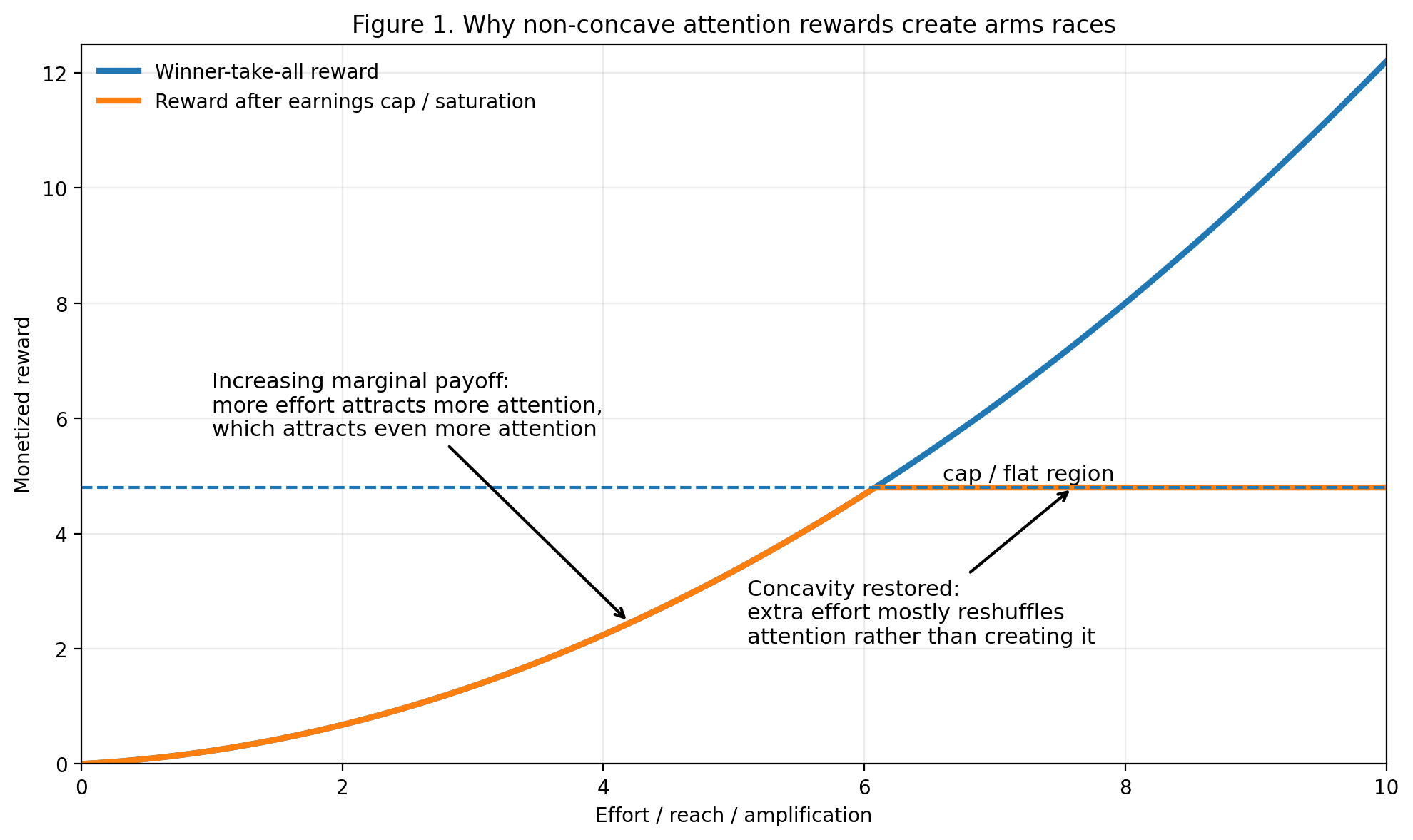
Figure 1: A stylized sketch of the argument. In the convex region, marginal returns rise with effort; after capping/saturation, marginal returns flatten and the tournament pressure falls.
Yet, it also has immediate implications for how we should think of the problem and its “solutions” in more market-based traditional western economies. For such societies, salary or earnings or reward caps may be difficult to swallow. With convex returns, the returns to attention are not capped. And one does not want to cap. This is why, to me, its not surprising to see a lot of financial interests actually buying media organizations and why there are concerted attacks on community or public broadcasting (but its naive to say there are not known quality issues…). This type of platform control is a way to “shape” the layer of influence over societies. So, how else can one achieve a similar outcome?
Topology Is the Other Lever
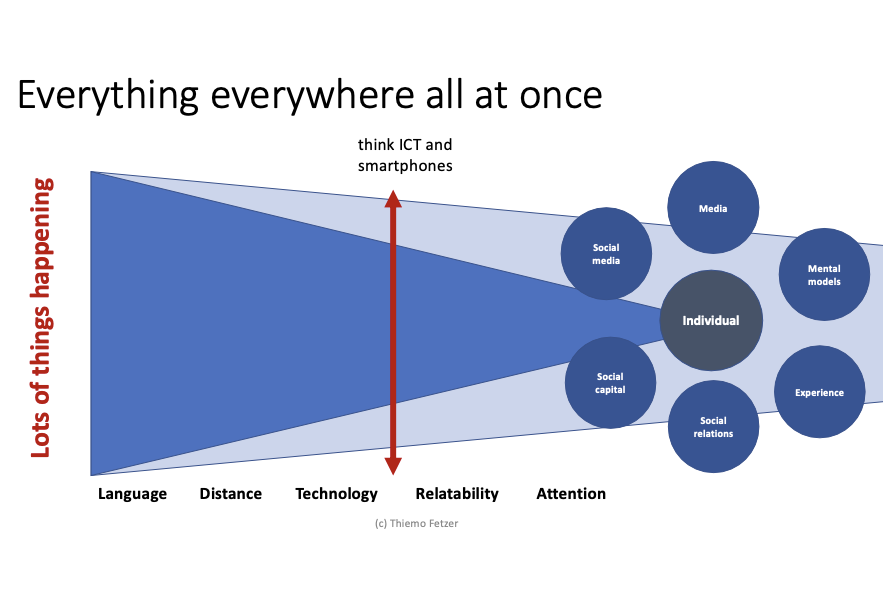
If dissemination happens through one highly integrated graph, global spillovers remain strong and the reward to concentration stays high. But when the ecosystem fragments into differentiated clusters, the strategic landscape changes. Attracting attention from distant clusters becomes harder, identity starts to form and this often involves the creation of new norms, styles of communication etc. that effectively exclude or serve to exclude individuals from different communities. With a flatter topology, local saturation appears sooner, returns flatten. Meaning: a fragmented social media topology across many platforms, which is precisely what is happening, could effectively have similar effects compared to an earnings cap. And of course, the logic applies to other forms of networked based platforms or industries, or even the idea of brands.
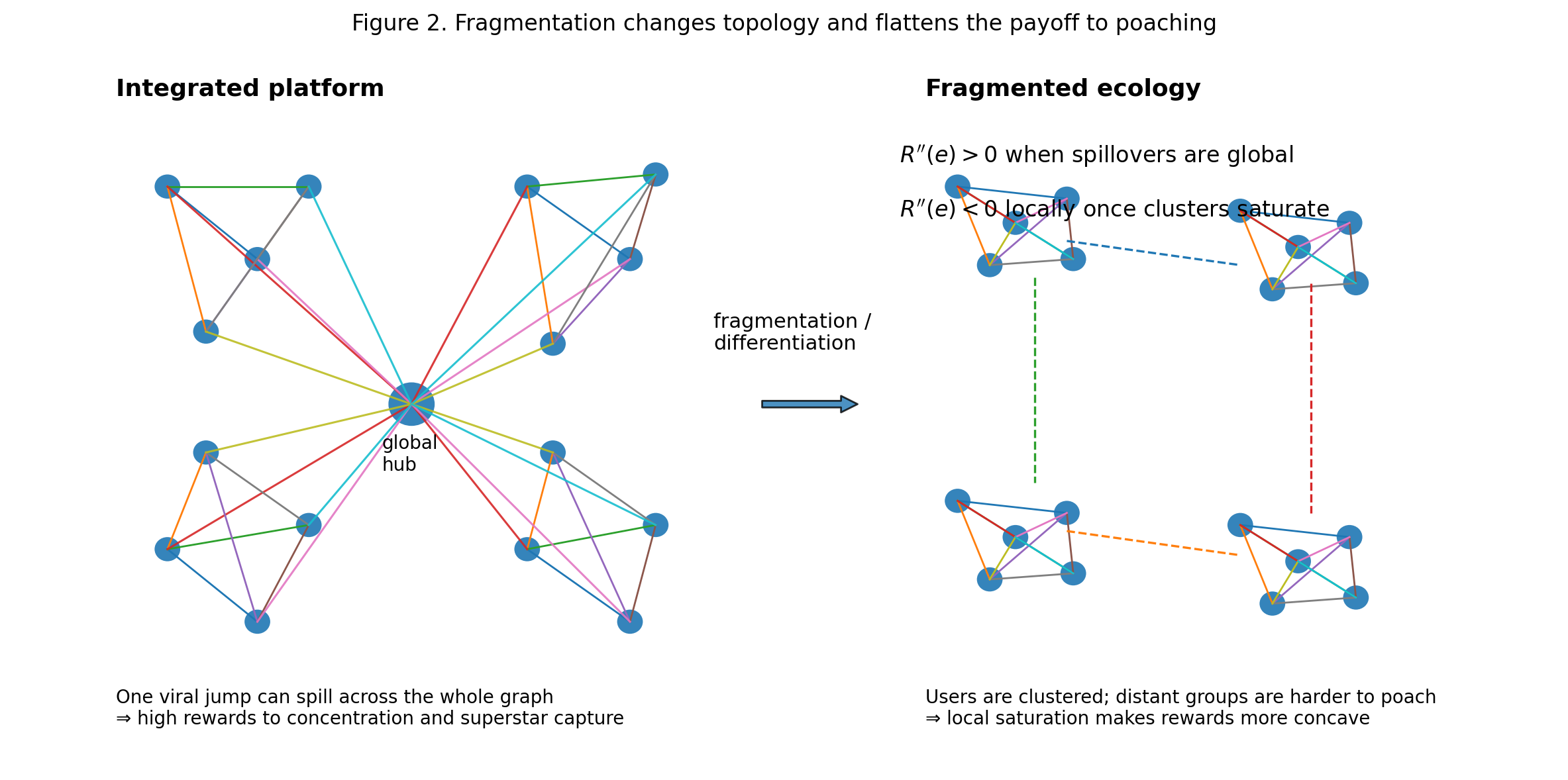
Figure 2: The move from one integrated attention graph to a more clustered ecology. Fragmentation can mechanically reduce the payoff to global poaching and superstar capture.
This is basically the same IO point in a different language. Winner-take-all competition in integrated graphs resembles a brutal fight for the whole field. Differentiated ecologies look more like local competition with niche dominance and earlier saturation.
So diversity is not cosmetic pluralism but a simple incentive design feature. And there are many good reasons why this exists well beyond due to the role that information markets play more broadly.
Why This Matters Beyond Social Media
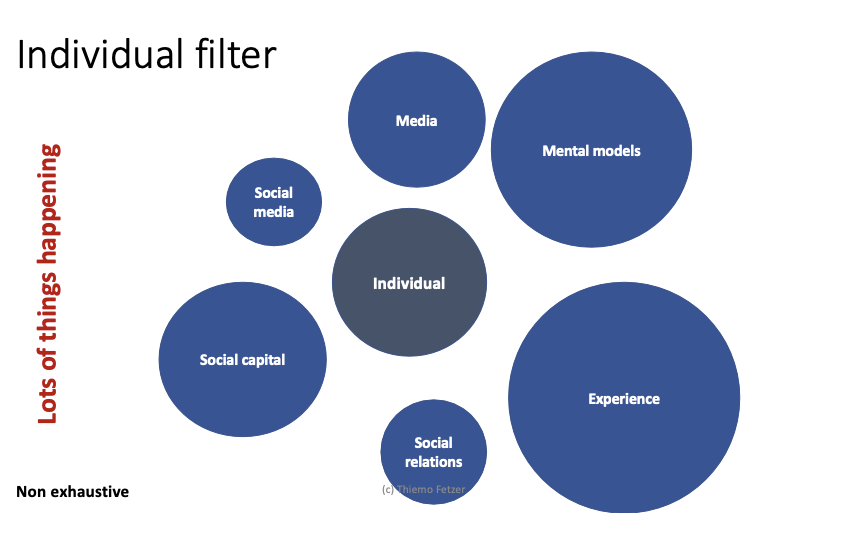
What worries me is that this logic extends into knowledge systems themselves. In the work on the political expression of academics online, we showcase that US-based academics stand out in their language use on social media that may, well, be particularly “successful” in mining attention. To me the fact that US based academics, stand out with more egocentric/toxic/emotional language use, on average, suggests to me this is producing content that may “work” particularly well in social media and the attention game.
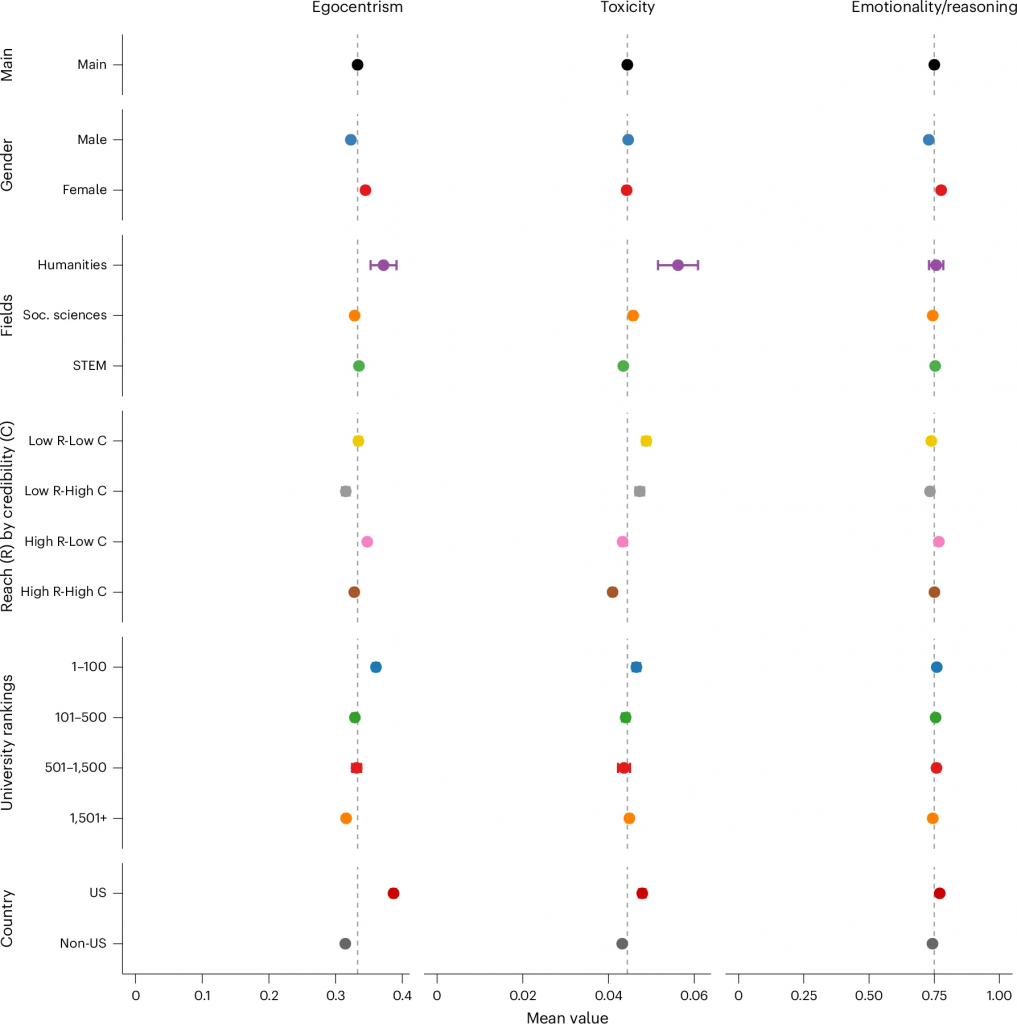
Of course, there is a whole selection margin here. But the point being, the implications of this understanding of social media may well extend to other markers or societal reward functions to allocate authority, such as academia more broadly.
In recent reflections on narratives and validators and on research topologies and AI, I argued that once status and visibility rewards become too steep, research effort can drift toward what is legible, viral, and strategically useful, rather than what is curiosity-led or socially valuable. This is a normative statement, but I saw this with some people, how the “attention rewards” seemed to have had an effect on behavior. This is naturally highly problematic in many ways.
In the piece on research topologies I articulated that curiosity-led research could effectively become a pathway of destabilization, if the curiosity itself actually — “being led” by the elusive attention rewards possibly awarded by wayward use of language, or, possibly even just by chance or coincidence (which also happens).
That same concern now appears across many institutions. If attention rewards dominate epistemic rewards, the system systematically overproduces symbolic conflict and underproduces validation. It doesnt aid that AI is supercharging visible output creation. So, in a world where influence can be targeted through focal actors, superstars become systemic vulnerabilities.
This also links to a broader argument I made in Fragility and the State of Global Governance: modern governance failures are often failures of informational architecture. We keep debating outcomes while leaving the underlying incentive plumbing intact.
The Interior Optimum
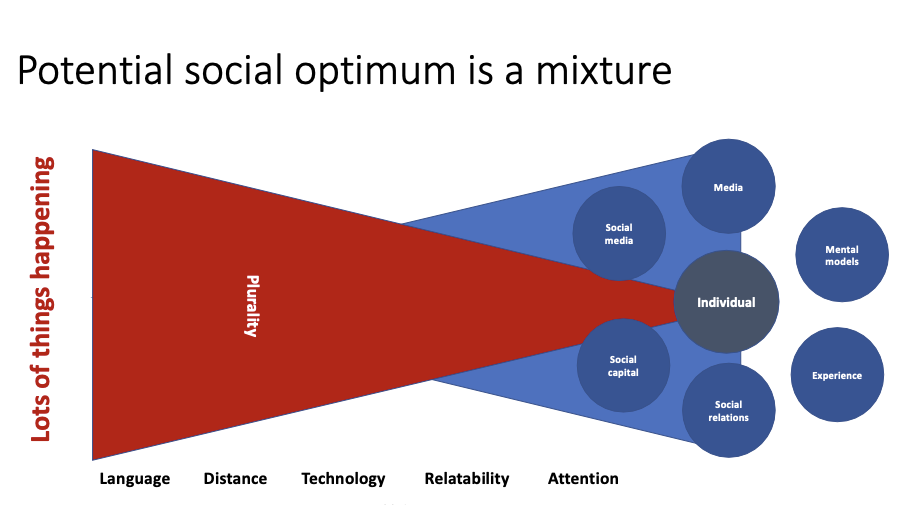
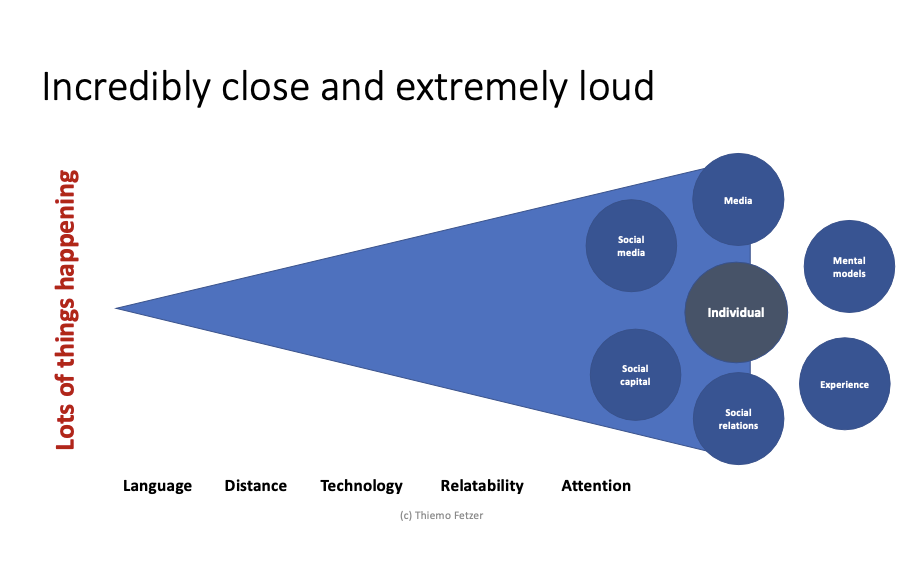
None of this implies that maximal fragmentation is socially optimal. A fully fragmented information environment can destroy shared observability and common factual baselines. Narratives and stories are important anchors of shared belief systems and said belief systems are important for the well-functioning of societies and communities. Fragmentation can put that at risk which could be hugely destablizing. And so, there must be a social optimum that lies somewhere in between as I posited in the 2023 SHAPER slides with a new intermediation layer that may be able to traverse these fragmented communities.
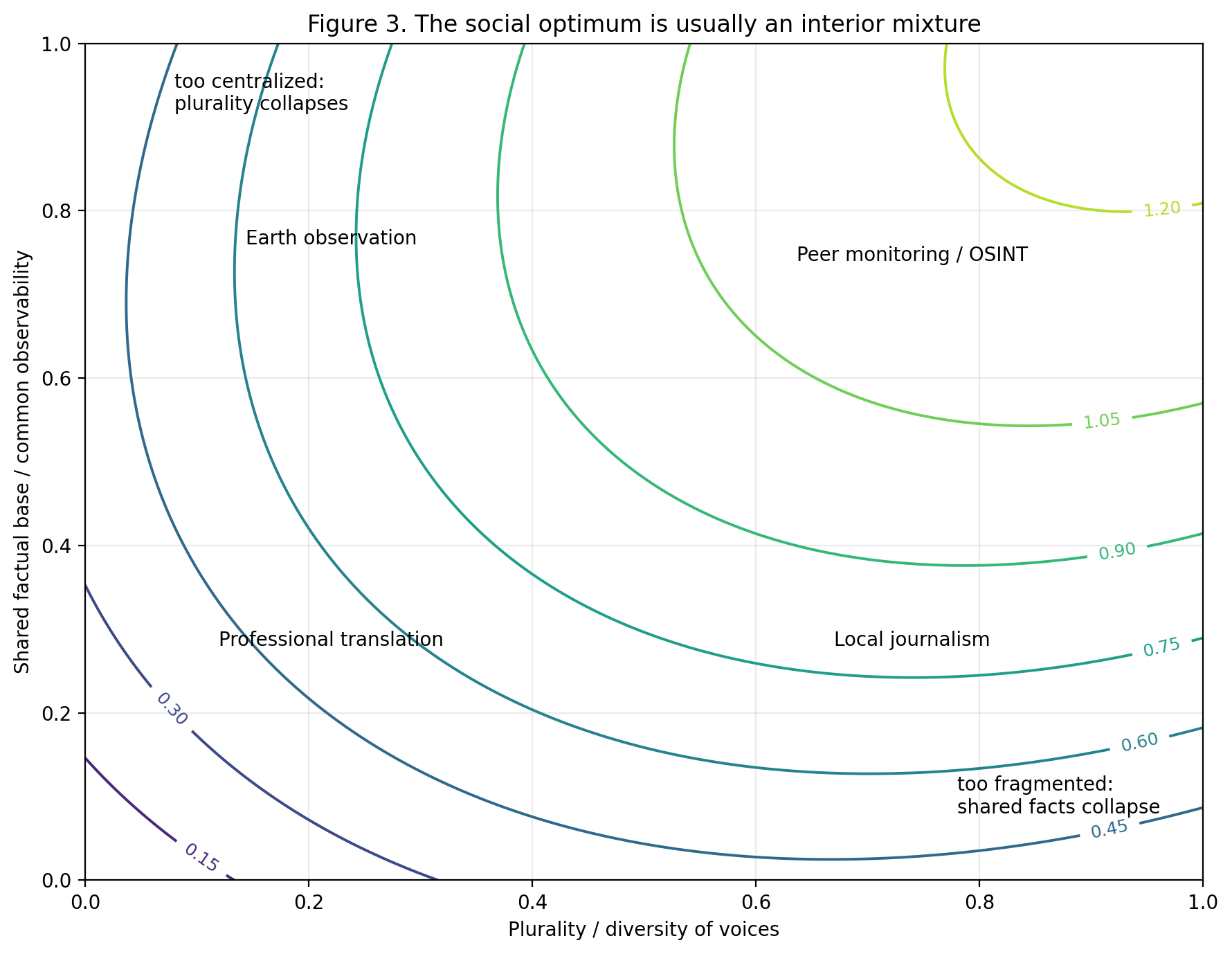
Figure 3: The welfare objective is typically interior, not extreme centralization and not total fragmentation.
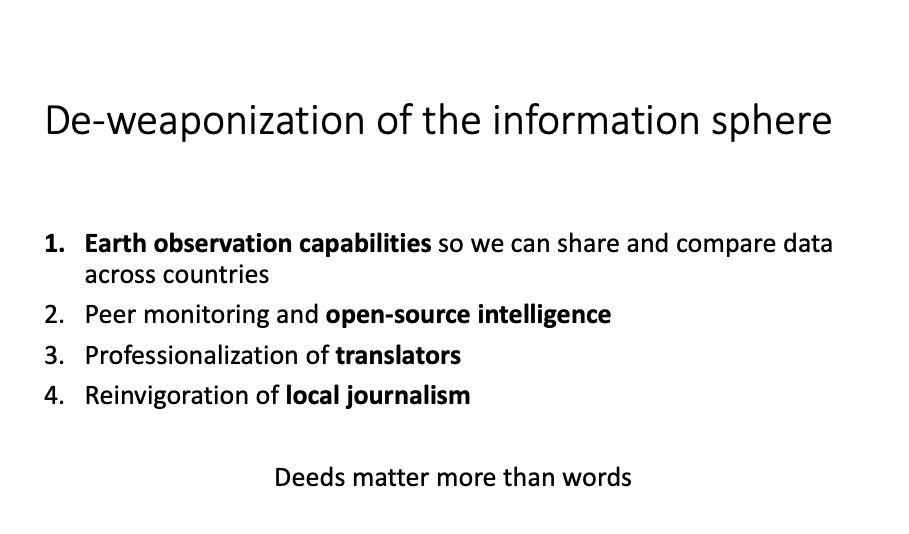
In practice, this points to public-good complements that raise observability without forcing everything through one dominant platform logic: local journalism, peer monitoring and OSINT, translation infrastructure, and open evidence systems.
Wider Motivation and Ongoing Work
This post is a conceptual note, not a claim of finished empirical proof. Parts of the mechanism are grounded in ongoing and forthcoming work. I want to stress the work here by Jasmin Hao, which is useful for thinking about how incentive curvature and market structure jointly shape equilibrium outcomes and how policy interventions may help make media and narrative systems more stable.
The core argument I want to stress is narrower:
- Attention systems are not neutral marketplaces.
- Their payoff shape can induce tournament dynamics.
- Tournament dynamics create zero-sum escalation and strategic distortion.
- Curvature and topology can be redesigned.
- Institutional design, not just speech norms, is the policy frontier.
Put differently, de-weaponizing the information sphere is not mostly a language problem. It is a mechanism design problem, but equally, since shared narratives are a tool of policy making and policy shaping, yes, a vector along which identities form and in which norms develop, it always, just like any topic in the social sciences, will have a political economy dimension to it.
Related Reading
- Thoughts on narratives and the role of AI and validators going forward
- On research topologies, AI, the potential threat to the enlightenment consensus and rebalancing of power
- Fragility and the State of Global Governance
- Human embeddings
- Narrative Reset
- Electoral surprises and business cycles